Thursday, June 16, 2011

All our veterans deserve to be honored this Memorial Day | Opinion - The Puyallup Herald

The following was originally published in the Puyallup Herald

With the approach of Memorial Day I begin to think of all who have served in the military, especially friends and family. Technically, Memorial Day was established to honor and remember those who died in service to our nation, but I know of no family member or close family friend who I can so memorialize.

My father, grandfather, brother, father-in-law, and a number of uncles all served honorably in the military.
My maternal grandfather, Edward Bertram, was commanding officer at Vancouver Barracks when my parents met. It was 1941, and Dad was the new officer on base. He quickly charmed his way into Mom’s heart. Hal Brown and Kitty Bertram married after a short engagement.

A year later Grandfather Bertram was dead from heart disease and America was at war in the Pacific and Europe. Dad would return home in 1945 after serving in New Guinea and The Philippines, suffering from a combination of malaria and dysentery. He spent months in a hospital recovering.
Dad's 1944 Christmas Card to Mom

By this time he was also a dedicated smoker. There is some uncertainty as to when he picked up the tobacco habit. My sister thinks it was prior to his admission to West Point. I’m having a hard time reconciling that with the fact that he ran cross-country and was the number two miler on the track team.
What I do know is that many of our military men who served in World War II picked up the habit due to cigarettes included with their C-rations, or those distributed by certain non-governmental organizations.

In 1946 Dad was sent by the Army to the University of Chicago to study nuclear science. He received a Master’s Degree in 1948. During his time there, he was hospitalized when a canister of chlorine gas was accidentally breached in a lab while he was working in another part of the building. His lungs were blistered, leaving them scarred.

After finishing his degree, Dad spent the next several years building bombs in New Mexico. I don’t know much about the safety precautions taken around radioactive materials in those days, but I would hazard a guess that he was exposed to considerably more radiation than the average Joe working in a factory.

We can never know how many of our veterans died prematurely from service related injuries. Dad spent the final years of his life struggling to breathe, a nebulizer always at hand. No doubt the cigarettes he smoked for most of his life were to blame, but the chlorine gas cannot be dismissed.

So on Memorial Day I will be honoring those who died bravely in combat, but I will also be thinking of those whose fates are not easy to connect to patriotic duties: Those who returned from World War II addicted to tobacco; the veterans who were exposed to toxic chemicals in uniform; those with mental illness due to post-traumatic stress who died alone on the street.

All deserve to be honored.

Wednesday, June 15, 2011

Music is more meaningful when it has a close, personal connection

The following was originally published in the Puyallup Herald.

Did you catch PK Dwyer's show recently at the Puyallup Farmer's Market? I didn't. Had I known he was performing, I'd have been there.

Dwyer was a significant figure in Seattle music in the 1970s and 80s. Credited with being the first busker at the Pike Place Market, he also fronted the groundbreaking Seattle band, The Jitters. I know this because I own their 1980 LP, which leads off with the memorably titled song, “Don't You Remember That You Are the One That Burned Down the Bridges That I Built Over Rivers of Tears That I Cried Over You.”

Once, when I was working at a fast food place in college, Dwyer and the other Jitters walked in and ordered some road food. He wore sunglasses, and if I recall correctly, jeans and a sport coat. But what made him memorable was his hair. It was light-brown or blonde hair, styled in a sort of unruly shag-do, his head nearly disappearing in its immensity.

Dwyer has been making music on his own terms for decades, preferring to perform on the street or in small, unique venues. His occasional recordings have garnered great reviews and an award or two. Oh, and nowadays that immense hair has migrated south to his chin, where he sports a Meeker-esque beard.

Kim Field in the 80s
But he wasn't the only northwest musician I've been catching up with in the past couple of years. While digitizing some old negatives I shot at Bumbershoot, I wondered about the subjects of those pictures, a blues outfit called The Slamhound Hunters. With a little research I found out the harmonica player and lead vocalist, Kim Field, now fronts The Mighty Titans of Tone in Seattle, and published a terrific book on the history of the harmonica.


Then, while browsing Facebook looking for Field, I came across a duo known as Funk Mason. Carl Funk and Larry Mason had been key members of The Allies, one of the most successful Seattle bands of the 1980s, gaining national exposure on MTV's Basement Tapes. After spending some time in New York, both came back to Washington. For ten years or so they played regionally as an acoustic duo.

A little more than a year ago they teamed with local boy and Grammy winner Eric Tingstad to form The Halyards. They released a well-received CD, “Fortune Smiles,” and have been performing regularly in the Puget Sound region.
The Halyards


At the U2 show at Qwest Field recently, I had my wife Laurie take a picture of me proudly displaying my Halyards t-shirt, with the gigantic stage in the background. U2 was an almost overwhelming experience, with the high tech audio-visuals and crowd of 70,000 roaring for the biggest rock band in the world. But the importance of musicians like Dwyer, Field, Funk, and Mason looms large in my life, pushing the megastars down the list of music I can’t live without.

Lesson learned: Check the Puyallup concert listings regularly.

All photographs by Michael Brown


Monday, September 27, 2010

What are the limits on a teacher's time?

A teacher at "Education Nation" suggested that union rules regarding the teaching day limited her ability to meet the needs of her students and she just wanted to "do my job." She wondered why she wasn't allowed to bring students in on Saturday to do extra tutoring with those who needed it.

My simple question to her is: Where do you put limits on your time? Most teachers I know, myself included, put in time beyond the contract. Today I worked one hour forty-five minutes beyond my contractual obligation. On this past Sunday I spent three plus hours in my classroom grading papers and planning. I also scored papers at home on Saturday and Sunday. I brought home more papers to score tonight.

When I was a young teacher, I put in many more hours than I do now. Of course, I was living away from family and friends, and had no social life to speak of then. Now I'm older and have a wife and son. My energy level is not what it was. Tell me, what is a reasonable expectation of my time as a professional? Do I reach my limit when I drop dead?

Saturday, May 22, 2010

Bootstraps

Many people have succeeded in life by pulling themselves up by their bootstraps, as the saying goes. These people are to be admired for their determination and grit. We often use the same phrase as a suggestion to those who are struggling. "You just need to get up off your duff and pull yourself up by your bootstraps!" some have been heard to say. The problem is that not everyone has bootstraps, or boots for that matter.


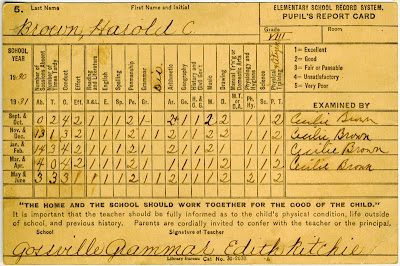
Seventy years ago this June 11 my Dad, Harold Clifton Brown, graduated first in his class from West Point. Born the first son of an electrical engineer and a Norwegian immigrant who had briefly written for silent films, things looked pretty bright for his future from the start. He soon had two brothers to play with and his parents were doing pretty well providing for the boys. His dad, Harold senior, worked for Pennsylvania Power and Light. He was called "Brownie" by Grandma Brown, and she took care of the boys and the home. When Dad was about six, Brownie died of a sudden illness, leaving Grandma to provide and care for three young boys. It was 1924.

Through the worst of the Great Depression Grandma Brown worked hard and raised the boys. Dad did pretty well in school, except in the area of conduct.
Third column from the left is Conduct, preceded by attendance numbers. According to the scale it was his worst area.

Yep, Dad was a bad boy with potential. This was recognized by U.S.Senator Fred Brown (No relation. And no relation to the former Seattle SuperSonic.) of New Hampshire who appointed Dad to the U.S. Military Academy at West Point, New York.


Dad continued to work hard once at West Point and in the end was incredibly successful. He served in World War II with the Corps of Engineers, earned a Master's Degree in Nuclear Science at the University of Chicago after the war, and eventually retired as a Colonel. He went on to work fifteen years as an analyst for Boeing.


Funniest caption ever.

So dad had a bit of a rough start, but his life by most standards was successful. He certainly pulled himself up by his bootstraps, wouldn't you say?

In no way do I consider myself the success Dad was. I went to college, reluctantly. My record as an undergrad was undistinguished. I flailed around at a variety of jobs for six years afterwards. Something finally clicked and I got my teaching credentials with a 3.74 GPA. Since then I've been gainfully employed as an elementary school teacher. But I didn't pull myself up by my bootstraps. Couldn't find them. So how did I get where I am? I'm white, male, grew up in an upper middle-class community, and I'm the son of a very successful father and saintly mother. Had but one of those puzzle pieces been missing I might be missing too (See Depression).

So when I hear or read about people using examples of others overcoming long odds to "make something out of themselves" to justify criticism of those who fail at same, I get agitated. Sometimes I even get hot under the collar. On rare occasions it gets my back and my dander up. Way, way up. If someone opines that you should stay out of the kitchen if you can't stand the heat, well, better make yourself scarce, because that's one too many cliches.

Sometimes people need help to simply lead a normal life. We all are products of our families, communities, nations, and genetics. Fortune determines the variety and quantity of each. Genetics can impact ambition, health, and talent. Our families impact our self-image, values, and attitudes. Community and nation provide opportunity, resources, and security. If fortune is kind we find it easier to make our way in the world. If fortune shorts us in one or more areas we struggle a bit more. If too much is missing, ambition can find little room to grow.

So, when I see the alcololic homeless man vomiting by the side of the road I try not to judge him. I don't call him "loser." I see the me that might have been had my circumstances been slightly different.

Sunday, May 09, 2010

Anger, Part II

In the paper this morning: "blobs of tar washed up at an Alabama beach full of swimmers... the ominous arrival of the sticky substance at Dauphin Island, Ala."

It took longer than I expected, and I didn't expect it to be the first landing spot, but there it is. Our friends on Dauphin Island have suffered the loss of one home (totally washed out to sea by Katrina), and severe damage to a second (flooded by Ivan) in hurricanes, now this. I can't imagine it won't get worse.

This photo, taken in April 2005 shows Mississippi Sound, which is between the island and the mainland. Right of center is an oil drilling platform. To the left of it near the center you may be able to make out the profile of a ship, probably an oil tanker. Flying in formation in the upper right corner are a half dozen Brown Pelicans, one of the species most impacted by DDT and removed from the endangered species list just last autumn.

Sunday, May 02, 2010

Anger

John SherffiusI'm angry at British Petroleum. That iconic "BP" logo that I first noticed in movies and images of motor sports events is now nothing more than a symbol of corporate greed and irresponsibility. Human beings died, now wildlife is dying and our tax dollars go to work to clean up "Big Petroleum's" mess. We don't even know what the scope of this disaster will be.


Five years ago I stood on a beach on Dauphin Island, Alabama watching Northern Gannets diving far offshore into Mississippi Sound. You may have seen film of them on Discovery or PBS in the past. They start the dive high above the water. As they near the surface they fold back their wings, extend their necks, and plunge dagger-like into the water in pursuit of their prey. This occurs in large flocks and is a spectacular sight to see. There was a photo in the paper the other day of a worker cleaning the oil from the feathers of a Northern Gannet. Dauphin Island is directly north of the source of the spill. Enough said.

Monday, April 26, 2010

Teaching is Not a Life Commitment

When I was a new teacher I spent an average of ten hours a day at school. That does not include weekends, when I often put in an additional half-day. I would arrive in the morning before most staff, other than the chief custodian. I would stay late and have a fast-food dinner on the way home. Not the best for my health, but I didn't really think about it. I was thirty-one, in good health, full of energy, and single. I was also three thousand miles from home, so I had no social life. Many of my colleagues were married so I didn't hang out with them. The single ones were not so new to teaching as I, and we really didn't have much else in common.

After that first year, I moved home and eventually went to work for my current employer. As the years went by, I continued to put in long hours at school. I also remained single. The average length of work-day gradually decreased, but not rapidly. When I turned forty, still a single man, I thought, "I'm still not married, but no biggie. I'm a good guy, educated, have a steady job, own a house, and I like kids. Ummmm, why am I not meeting eligible women?"

To make a long story short, I'm now married. We have a healthy, energetic five year old son. Really, really energetic. We have a house with a yard, both of which need upkeep. We both have families, friends, and interests which need attention. I still arrive at work earlier than required, leave later than required, and I work on weekends, but the hours are fewer. I don't expect to ever be recognized as a star educator. I'm no Jaime Escalante. I don't want to be. What I want is to be recognized for what I do well. Then I want to be told, with manners and respect for my education, experience, and humanity, what I need to do better. I want to be given a chance to fix those weaknesses in a way that makes sense to me. I don't want to feel manipulated by legislation, bureaucrats, or politicians, and most of all, I don't want to be the target of threats, insults, or intimidation by educational leaders or parents. That's not an unreasonable expectation, is it?

Saturday, April 24, 2010

Depression

I am not religious. I haven't attended church on a regular basis since I was about fifteen years old. To that point I was a Roman Catholic. I had gone through Confirmation and First Holy Communion. I even tithed, intermittently anyway. There was a certain comfort in childhood in attending church on Sundays, going to midnight mass on Christmas Eve, or being smudged with ashes on Ash Wednesday.

Mom was a devout Catholic and I know she wanted her children to be the same. I think it's safe to say that none of us turned out as such. Because Dad was not a Catholic I did not face much pressure as I began drifting away from church. I know Mom wasn't happy, but there was no anger. She just looked sad. I never spoke to her about my reasons and she never asked. She died of breast cancer six years later.

What it came down to was unhappiness. I seldom felt really, truly joyful as a child and a young teen. Doing all the right things in my church never made any difference. Happy times always seemed to be experienced through a filter of haze. While I had a few close friends, many of my peers teased me, especially as I began to gain weight through my obsession with junk food and television. Thankfully, time has helped me understand what I now believe caused that hazy filter. Depression.

About ten or so years ago, listening to my future wife describe her own symptoms and experience with depression I realized it sounded much too familiar. I had never had a name for it until then, had no way of asking for support because I didn't understand and I feared being judged.

A few years earlier, after months of the worst symptoms, I described my experience to my doctor. He had no clue whatsoever. No diagnosis. Nothing. I went back to the same doctor after learning about depression, and asked him if I might have depression. He gave me a brief questionnaire, reviewed it, and gave me a prescription. That first prescription actually made my symptoms worse, but things have gotten better over the years. I've since changed health care providers.

I could not even begin to tell you how many people have tried to draw me into their religion over the years.  My thin veneer of normalcy did not conceal my core of sadness, making me an obvious target. Let's start with the Hare Krishna in San Francisco in 1974 when I was seventeen who called me a "far-out guy." I walked away with a book I didn't want and less money than I started with, but I was too polite to say no. Then there was the time a high school buddy and I were approached outside the Seattle Scientology office, and asked to take a "personality test." When they found out we were under age they quickly moved on. There have been more Jehovah's Witnesses than I can begin to count. Once, a JW woman came to my parents' house offering literature. Strangely, I came to know her several years later as the bride to be of my step brother, also a JW. Nice enough people, but why do their churches tend to be window-free? Not a good fit for claustrophobics. I sat next to a Mormon missionary on a Greyhound during my freshman year in college. Once he knew there was no chance of me converting, we were able to discuss music for the rest of the trip. When I was thirty I ended a seven year friendship because he could not stop proselytizing. I had been one of his groomsmen. I question that decision to this day, but I feel talked down to anytime people treat me as though I've had no experience with or knowledge of their religion. Ultimately, it wasn't religion that helped me take the first step on the road to wellness, it was knowledge.

Then there are the people who simply practice their beliefs with no expectation that those around them be anything other than what they are. If anyone will bring me back to church it is these people. They treat non-believers like human beings, not objects to be manipulated. They lead with their joy. They live their lives fully and meaningfully, setting an example which your average televangelist cannot. They will never carry garishly colored signs with cruel messages at the funerals of fellow Americans who gave their lives in hopes of  preserving freedom of speech. You won't see them blowing themselves up in a crowded public space on the evening news. And they won't beg for your money to support their "ministry" on channel 96 at 2 a.m. More than anything else, they won't call for a "holy war" or burn heretics and witches, real or imagined, at the stake.

During my most recent depression flare-up I made a 40 mile drive to visit with an old friend. I made a point of it because I knew the support of friends and family is an important element in the treatment of this illness. My friend is the minister of a Presbyterian church in an urban area. I couldn't have predicted such an outcome for him thirty-five years ago. As we enjoyed lunch at a neighborhood cafe he listened patiently to my story and was very supportive. Not once did he suggest that I make any spiritual changes in my life. He simply affirmed my feelings and concerns. After lunch we drove back to his church. I had brought along my camera equipment because I wanted to take some pictures of the interior of the beautiful church. He left me there as he headed off to an appointment. I stayed another thirty minutes or so, inside a church of my own volition, not as a guest at a wedding, or a mourner, or tourist, for the first time in almost forty years.

Wednesday, April 21, 2010

Using the Sandbox

This morning I saw a cat using the sandbox, and by sandbox I don't mean litter box. In a neighbor's yard is a child's sandbox and in the child's sandbox was a cat. The cat was scratching in the sand, and you know what that means: Little gifts awaiting the children who play in that sandbox. This is not an isolated incident. Cats find these play areas to have perfect conditions for their potty needs.

Other perfect kitty commodes include flower beds, vegetable patches, and garden paths, but that doesn't end the opportunities for cats to do damage to your property. Young trees and fence posts make wonderful scratching posts. Your car's tires are a perfect target for their spray, not to mention the paint!

I gotta tell ya', there's nothing quite like weeding the garden and unexpectedly grabbing a fistful of cat crap. There is also nothing like the "magnificence" of watching a well-fed, pampered, healthy feline stalking its feathered prey, pouncing on it, then tormenting it for twenty minutes or so until it finally, mercifully, and needlessly, dies.

Of course, there are controls for wandering cats. They're called coyotes, stray dogs, busy streets, leaking antifreeze, cat hating humans in three ton vehicles, and occasionally, large raptors. When I was in third grade, I visited a classmate's farm and saw the damage done by a barn owl. Several dead kittens were scattered around the property in various states of wholeness. I was horrified to see one with its eye hanging out of its socket. That image is still pretty vivid 45 years later.

None of this is necessary. If you love your cat, keep it indoors. Build it an enclosure if you must let it go outside, or leash train it. I've seen it done.

Could you be a communist and not realize it?

We've been hearing a lot about the "socialist agenda" of President Obama. Forcing people to buy health insurance? Socialism! Bailing out the failing banks? Socialism! Saving GM? Socialism! Friendly to organized labor? Socialism!

I once had a conversation with a relative regarding a large corporation which had recently moved its headquarters from its historic home to a new city half a continent away. I saw this as a sign that the corporation did not care about the community which had been part of its growth and success. In addition, I believed this was a move designed to put distance between executives and the unions representing the bulk of its employees. It was clear my relative dislikes unions, and he suggested that giving too much power to organized labor is just a step away from communism.

His comment really upset me. I am very liberal politically, but I am absolutely anti-communist. The reason is the atrocious human rights records of communist nations, including China. In fact, I am strongly opposed to any government which curtails the basic rights outlined in the Universal Declaration of Human Rights. Dictators, authoritarian regimes, military juntas, or any form of government which uses intimidation, torture, incarceration, terror, or other methods to cow its citizens into passive compliance deserves no respect from people who value justice, equality, dignity, life, speech, art, or other features of a free society.

So, to those of you who think that our president is a closet commie, take a look in the mirror. Then take a look around you. That new flat-screen TV you treasure may have been made by communists. Those inexpensive toys your children are playing with? They are likely touched by the skilled hands of commie labor. Okay, I know some of them may have been made in non-communist places like Mexico or Singapore, but they have their own issues of repression to resolve.

I think the U.S. Senate needs to start an investigation into this subversive group of activists. Are they hiding their true nature by accusing the president of being the very thing they are? Could they be... communists?

Monday, March 22, 2010

Health Care Reform - Maybe

What I like about the health care bill:
  • No denial of coverage for preexisting conditions.
  • No dropping of coverage for people who become sick.
  • More people will have coverage.
What I hate about the health care bill:
  • People will be forced to buy coverage from insurance companies, because there is no non-corporate or non-profit option.
  • There are still people who will not get coverage.
  • Other things I can't think of at the moment!

Sunday, March 21, 2010

Horned Grebe at Marine Park in Tacoma


Horned Grebe
Originally uploaded by M.B.Brown
It was a gray Sunday, but a pair of very cooperative Horned Grebes led to this photo. The two were foraging fairly close together. One had started its transition to breeding plumage, this one still in winter plumage.

As I was leaving, a yellow lab drove them farther out from shore as it swam toward them. I don't know what the rules are at Marine Park, but I suspect it's not meant to be an off-leash area!

Monday, April 20, 2009

Tired of Education by Legislation

The Washington State Legislature is busy working on new ed "reform." Fifteen years ago or so, when I was still relatively new to education, that was the first time they laid "reform" on me. At that point they gave us the EALRs and the WASL. I was happy because I saw this as a more "authentic" measure of student progress, unlike the "bubble tests" popular at the time. Kids with learning disabilities struggled with those tests, trying to track where to mark their answers on the answer sheets. That was just plain cruel.

Now, after years I can describe only as miserable while trying to meet those standards, I am eager to see WASL's behind slinking down the hallway in utter failure. Veteran teachers I worked with at the dawn of WASL predicted it would eventually be gone and forgotten. They were right, but it took longer than they expected. I am anxious to see what takes its place.

Of course, my confidence has taken a major hit in recent years as I struggled to get my students up to snuff in the key subject areas, especially after the push of the Education and Secondary Education Act, otherwise known as "No Child Left Behind." I shall stick with the official title, abbreviated as ESEA. All I can say is, if the head cheerleader for ESEA is a model for what we hope for its goals, good luck. Test scores, especially a single, high stakes test given once a year are not the best way to measure the growth of children. The results of such tests are no way to measure the effectiveness of a teacher, either.

A few years back, I was singled out because my class did well on the Reading part of the WASL. I was quizzed as to my teaching methods, and it seemed I was thought of as some sort of fount of wisdom. The same year, my students' Math scores tanked. My response was, "If I take credit for those reading scores, I have to take credit for the math scores. No thank you. There are too many other variables at work here."

So, now I'm in the position of wondering, "When will this latest legislation fade into the black hole of "reform."

Wednesday, December 19, 2007

Birding or Bird Watching?

I have yet to really embrace the verb "to bird." I grew up knowing it as bird watching because that's what Dad called it. Many bird enthusiasts have embraced the verb, as well as the noun "birder." I tolerated that for some time, but not now.

About twelve years ago I took the Master Birding course from my local chapter of Audubon. It was a great course, with the identification classes taught by Dennis Paulson, a nationally recognized authority on shorebirds. Upon finishing the course, I was officially a Master Birder. Cool.

About four years later I was meeting some neighbors of my in-laws. One of them found my being a Master Birder to be quite hilarious, due to the fact that the term sounds similar to an activity not usually discussed in polite company. I am no longer a Master Birder. Nor am I a Master Bird Watcher. I'm just a bird watcher.

Even though I completed a course which entitled me to the rating of master, I've never really felt like a master. Advanced intermediate maybe, but not master. Frankly, I don't know how some of my classmates have found the time in their lives to get the bird identification practice needed to become as proficient as some of them have. I'm more than just a little jealous!

Friday, December 07, 2007

Winter Hummingbirds


I continue to be amazed at the resiliance of the Anna's Hummingbird. One or more always seem to hang around my feeder throughout the winter. When the weather turns really cold (around here that means anything below freezing) I always expect they will disappear and not return. I don't understand why these birds don't freeze solid in such weather. Those tiny little bodies, they have so little mass to them. Wouldn't they lose heat so quickly as to become hypothermic during the long cold night?

Thinking of this reminds me once again of the complexity and fragility of our world, and the impact we have on it. Humans have made more negative impacts on the natural systems and cycles of Earth than any other living thing. In fact the only thing I can think of that possibly can eclipse human despoliation of the planet is an asteroid impact or our Sun reaching supernova status.

There is one thing which makes an impact greater than any. Our global population is now beyond six billion individual lives, yet their are so many among those masses who believe they must procreate beyond all practical guidelines. Often they believe so for religious reasons, sometimes they are driven by perceived economic benefits. In wealthy nations they can afford to say, "I want to have lots of kids!" just because it sounds fun or is thought to be rewarding in some non-economic way. And our government rewards such thinking through yearly tax credits.

Then there is the philosophy that we must have a continuously growing population to keep our economy healthy, which I have long believed sounds like the biggest pyramid scheme in the history of the world. Or maybe it's the purveyors of actual pyramid schemes who advance this plan as a way to ensure there continued economic security. But it's always the ones at the bottom of the pyramid who wind up suffering, and in the global pyramid those will be the impoverished and powerless.

Thursday, December 06, 2007

Romney's Religion Speech

Mitt Romney today defended his Mormon faith in public. Among other things he argued that many citizens are trying to remove use of the word "God" from the public arena. He went on to say, "It is as if they are intent on establishing a new religion in America -- the religion of secularism. They are wrong."

What Romney has forgotten is that there are religions which do not believe in "God." Buddhists do not have a capital G "God," although I understand some elevate Buddha to the status of a god. Shintoists also lack the capital G "God," as do the Taoists and Confucianists (alright, I admit their is some debate about whether the latter group is actually part of a religion). There are others who practice religions with no god, capital G or otherwise. Removing the word "God" from the public arena would be fair, not secular.